
Welcome to the seventh lesson of the Master Course “Mind Architecture: Advanced Science and Strategic Memory Systems.”
In previous lessons, we explored complex visual techniques such as the PAV Method, the Chain Technique, and Image Agents. Today, we shift gears to analyze a verbal technique that, despite its apparent simplicity, represents one of the fundamental pillars of everyday memorization: Acrostics.
This technique is perhaps the most widespread in the world. It is used unconsciously by millions of people who are completely unaware of the existence of formal mnemonics. However, as we will see in this lesson, there is a profound difference between using an acrostic “by accident” and integrating it consciously into a structured mental architecture.
1. Definitions and Distinctions: Acrostics, Acronyms, and Initialisms
Before we dive into operations, we must clarify the terminology to ensure the academic authority that distinguishes Salyvan Academy students. These terms are often confused, but they indicate slightly different cognitive strategies.
The Acrostic
Etymologically, it derives from the Greek ákros (extreme/end) and stíchos (verse). Originally, it was a poetic composition in which the initial letters of each verse formed a word or a meaningful phrase. In mnemonics, an Acrostic is a phrase or sentence (often bizarre or logical) constructed using the initial letters of the words we need to remember.
- Example: To remember the order of the planets (Mercury, Venus, Earth, Mars, Jupiter, Saturn, Uranus, Neptune), we create a sentence where every word starts with the planet’s initial:“My Very Educated Mother Just Served Us Noodles.”
The Acronym
The Acronym is a word (existing or invented) formed from the initial letters (or first syllables) of a series of other words. The fundamental difference is that an acronym is pronounced as a single word (e.g., NASA, LASER), whereas an “Initialism” is read letter by letter (e.g., FBI, CEO).
The Principle of “Chunking”
Why do these techniques work? They are based on the principle of Chunking, theorized by psychologist George A. Miller in 1956. Our short-term memory has limited “slots” (usually 7 ± 2 items). Memorizing five distinct books of the Bible (Genesis, Exodus, Leviticus, Numbers, Deuteronomy) takes up five memory slots. Memorizing the single word “GELND” (or a mnemonic phrase) takes up only one slot. The acrostic is, in essence, a data compression algorithm for the brain.


2. Classic Applications: When Tradition Teaches
The acrostic technique allows you to remember a series of written information that may or may not have a logical relationship. It is the perfect tool for ordered lists.
The Musical Staff
A classic example taught in music schools across the English-speaking world concerns the notes on the lines of the Treble Clef: E, G, B, D, F. Memorizing this abstract sequence can be confusing for a child. But by applying the technique, we get the phrase:
- Every
- Good
- Boy
- Deserves
- Fudge
The sentence “Every Good Boy Deserves Fudge” creates a concrete narrative that guides the brain to retrieve the original information effortlessly.
The Great Lakes (Geography)
Another historical example is memorizing the names of the five Great Lakes of North America: Huron, Ontario, Michigan, Erie, Superior. By combining these initials, we form the meaningful word: HOMES. In this case, a complex geographical concept is reduced to a single, familiar concept: Homes. This is an Acronym serving the function of a mnemonic device.


3. Acrostics in Society: The Invasion of Sigla
Acrostics and acronyms are not just study techniques; they dominate the commercial, institutional, and technological worlds. Analyzing these acronyms helps us understand how much our brain prefers synthesis over verbosity.
Here is an in-depth examination of common acronyms, divided by category, to show the versatility of the technique:
Institutions and Civil Society
- WHO: World Health Organization.
- NASA: National Aeronautics and Space Administration. An acronym that has become a proper noun.
- UNICEF: United Nations International Children’s Emergency Fund. An international acronym that transcends linguistic barriers.
- POTUS: President of the United States. Used constantly in political reporting.
Economy and Finance
- CEO: Chief Executive Officer.
- OPEC: Organization of the Petroleum Exporting Countries.
- VIP: Very Important Person.
- WTO: World Trade Organization.
Technology and Web
- HTTP / HTTPS: HyperText Transfer Protocol (Secure). Here, the acronym hides enormous technical complexity behind 4-5 letters.
- RAM: Random Access Memory.
- LASER: Light Amplification by Stimulated Emission of Radiation. Most people don’t even realize “Laser” is an acronym!
- SCUBA: Self-Contained Underwater Breathing Apparatus. Another acronym that has become a standard noun.
International Relations
- EU: European Union.
- NATO: North Atlantic Treaty Organization.
Critical Reflection: As we can confirm from this list, the technique is widely used. However, there is a paradox: most people use the acronym (the “container”) while ignoring the exact meaning of the words that compose it (the “content”). How many people actually know that the “S” in LASER stands for Stimulated? For the Salyvan Academy student, the goal is different: the acrostic must not hide the information, but act as the key to unlock it.


4. How to Build an Effective Acrostic (Step-by-Step)
Not all acrostics work. To be a valid mnemonic technique, one must respect certain rules.
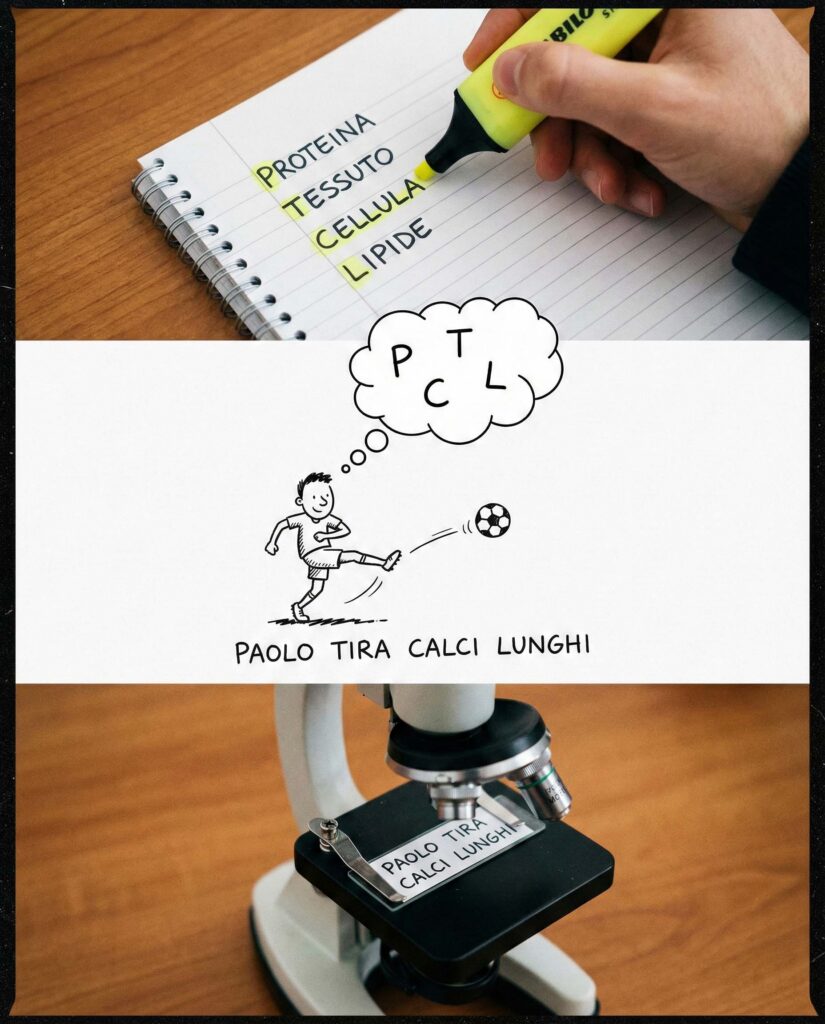
Phase 1: Extraction Write the words you need to memorize in a column and highlight the first letter (or the first syllable) of each.
Phase 2: Phonetic Analysis Read the letters in sequence. Do they already form an existing word?
- Example: If the initials are M, A, P, S -> the word is MAPS. You are lucky; use it.
Phase 3: Creative Integration If the letters do not form a word (e.g., P, T, C, L), you must create a sentence.
- Logical Method: Look for words that have a connection to the topic.
- Bizarre Method (Recommended): Create an absurd sentence. The stranger it is, the easier it is to remember.
- Example (P, T, C, L): Penguins Take Cold Lessons.
Phase 4: Consolidation Repeat the acrostic while visually associating it with the context. If the acrostic is about biology, imagine the sentence written on a microscope. l’acrostico associandolo visivamente al contesto. Se l’acrostico riguarda la biologia, immaginate la frase scritta su un microscopio.

5. Limits of the Technique: When NOT to Use It
For intellectual honesty and academic rigor, we must also analyze the flaws of this tool. The acrostic technique is a limited memory technique.
- Volume of Information: It becomes extremely challenging and confusing when the volume of data increases. You cannot memorize an entire anatomy chapter using only acrostics; you would end up having to memorize hundreds of nonsensical sentences, shifting the problem from studying the concepts to studying the sentences.
- Lack of Depth: The acrostic gives you the order and the name, but not the concept. Knowing that the “E” in HOMES stands for “Erie” tells you nothing about the lake’s depth or location.
- The “Blank” Risk: If you forget the key sentence, you have no other hooks to retrieve the list.
Integration into the Salyvan Method
For these reasons, at Salyvan Academy, we teach that the acrostic is not a standalone strategy, but a support technique. The winning approach is hybridization:
- Use Memory Palaces for the general structure of the speech or subject.
- Use Image Agents (PAV) for complex concepts.
- Use Acrostics only for small, sequential lists inside a specific “room” of your palace.
Example: In your “Palace of Medicine,” you enter the Cardiology room. There, you find an Image Agent explaining how the heart works. On a table in that room, there is a note with an acrostic to remember the names of the heart valves. This is true Mind Architecture.onamento del cuore. Su un tavolo in quella stanza, c’è un foglietto con un acrostico per ricordare i nomi delle valvole cardiache. Questa è architettura mentale.


Conclusion: Simplicity as a Strategic Weapon
In this seventh lesson, we have rediscovered a technique we thought we knew, elevating it from a simple “word game” to a strategic tool. We have seen that:
- Acrostics (sentences) and Acronyms (words) leverage the chunking principle to compress data.
- Historical examples like the Planets or Music Notes demonstrate the centuries-old effectiveness of the method.
- Our society is built on acronyms (NATO, CEO, USB) to speed up communication.
- The technique should be used sparingly and integrated with more powerful visual systems to overcome its intrinsic limits.
Never underestimate the power of initials. Sometimes, to unlock a complex memory, a single letter is all you need. volte, per sbloccare un ricordo complesso, basta una sola lettera.
FAQ – Frequently Asked Questions about Acrostics
What is the maximum length for an effective acrostic? Cognitive psychology suggests not exceeding 7 elements (plus or minus 2). If the list is longer than 7-9 words, it is better to break it into two different acrostics (Chunking).
Can I use acrostics for mathematical formulas? Yes, there is a variant called “alphanumeric mnemonics” where the number of letters in each word represents a digit. A classic example for Pi (3.1415…): “How (3) I (1) want (4) a (1) drink (5)…”
Is a logical acrostic better than a nonsensical one? It depends. If a logical acrostic comes to mind immediately, use it. But often, forcing logic makes the sentence boring. A bizarre, funny, or slightly rude sentence (yes, they work!) imprints itself on emotional memory much more easily.
Did you enjoy this lesson? Try creating an acrostic with your name or your grocery list and share it in the comments! Tag Salyvan Academy to show your progress.
INFOGRAPHIC:

