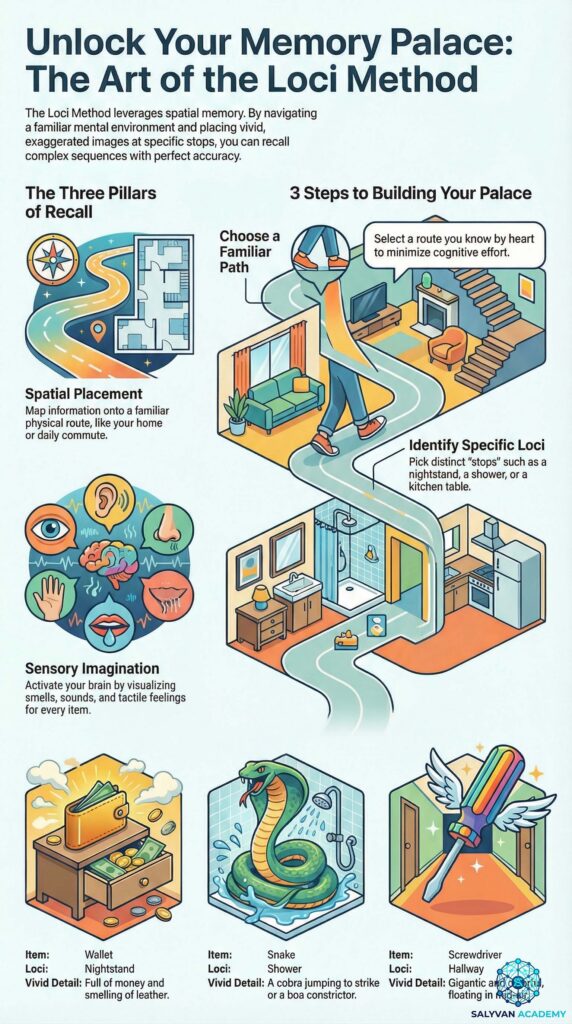
Welcome to the tenth lesson of the Master Course “Mind Architecture: Advanced Science and Strategic Memory Systems.”
In previous lessons, we studied the theory: the history of Simonides of Ceos, the discoveries in Neuron, and the logical structure of the Method of Loci. But memory is not a spectator sport. You don’t learn to swim by reading a book on fluid dynamics; you have to get in the water.
Today, we will do exactly that. In this lesson, we won’t just talk about how the Memory Palace works—we will build one together, in real-time. I will guide you through a practical experiment that will prove, beyond any reasonable doubt, that your memory is already perfect: you just lack the right software to manage it.
1. The Initial Challenge: The “Tabula Rasa” Test
To understand the power of this technique, we must first confront the limits of our natural memory (or “unassisted memory”).
Take this list of 10 random, totally unrelated words:
- Wallet
- Snake
- Screwdriver
- Watermelon
- Drum Kit
- Book
- Guitar
- Goat
- Mirror
- Tanker Truck
Try to look away and repeat them in order. You will likely remember the first two (primacy effect) and the last one (recency effect). Perhaps you’ll recall one in the middle that struck you, but the exact sequence is almost impossible to retain without repeating the list dozens of times. This happens because you are using short-term semantic memory, which has a limited slot capacity (Miller’s famous “7 ± 2”).
Now, forget the effort. You are about to memorize these words forever, in the correct order, and you will be able to recall them even backward.e, nel giusto ordine, e sarete in grado di richiamarle anche al contrario.


2. The Guided Exercise: Building the Path
The experiment we are about to conduct is not a memory test, but an imagination test. The secret of the Memory Palace is to stop trying to “remember” and start trying to “see.” We will use a place you know better than anyone else: your home.
Follow me on this mental journey. Close your eyes (metaphorically) and activate all your senses: sight, hearing, touch, smell, and taste. The more vivid, paradoxical, and emotional the images are, the more indelible the memory will be.
Stop 1: The Bedroom (Locus 1)
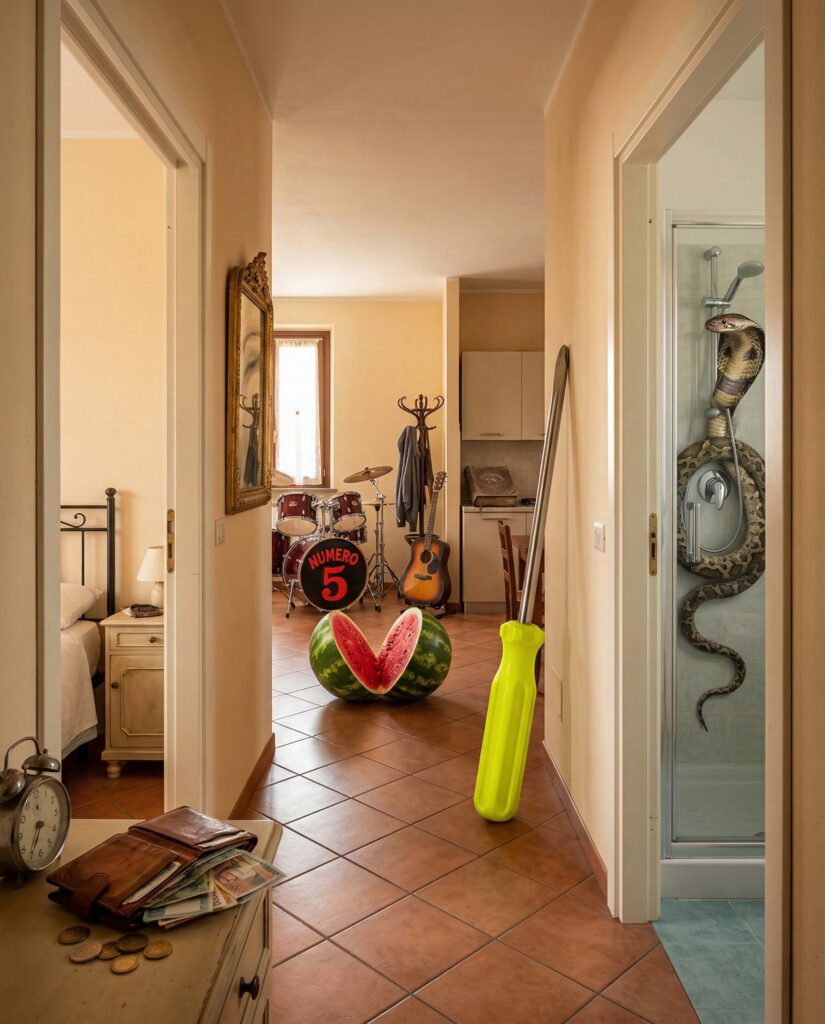
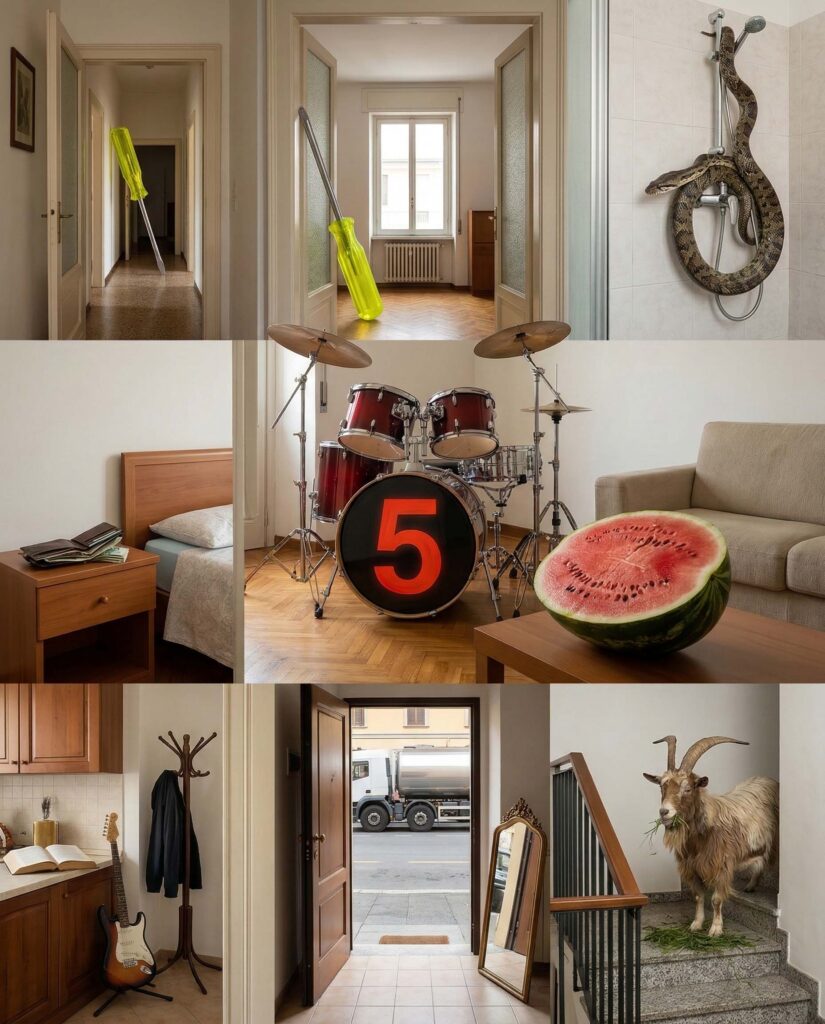
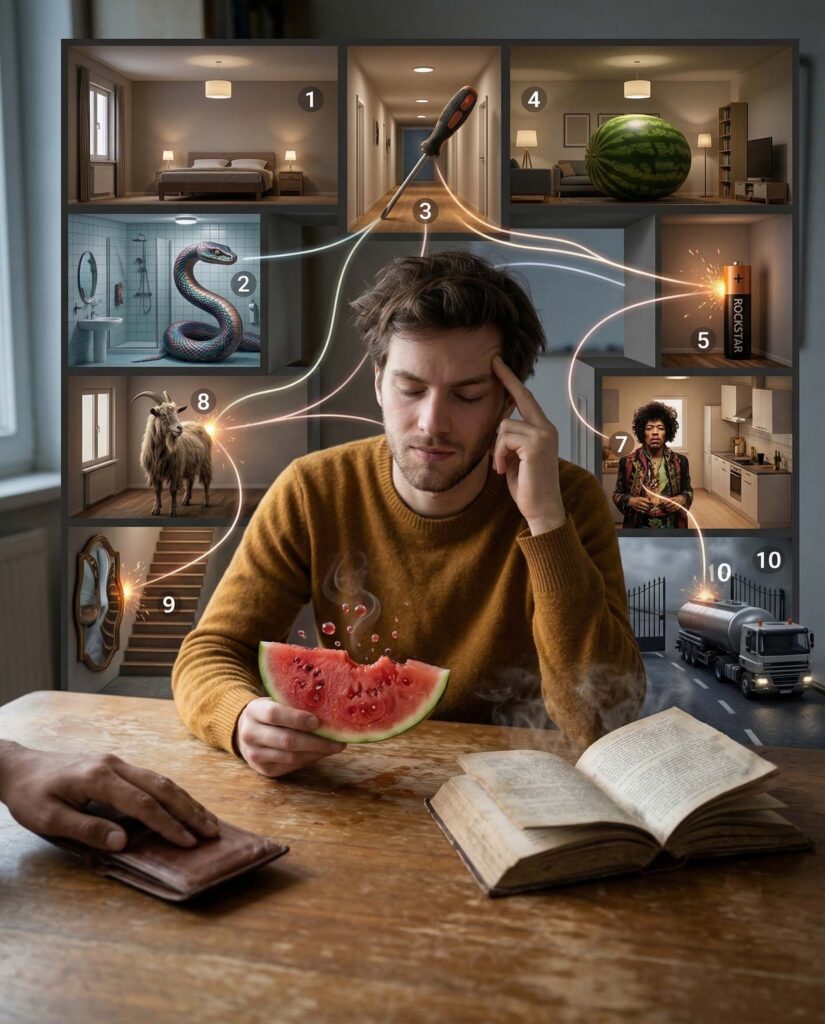
You wake up. You are in your bed, safe. You turn toward the nightstand, and right there, next to the alarm clock, you see a WALLET. Do not imagine a generic wallet. Look at it closely. What color is it? Is it old brown leather or black technical fabric? Smell the leather. Pick it up: it is heavy, swollen, stuffed with cash. Banknotes are bursting out of the slots. Feel the sensation of pleasure and surprise at finding this treasure right after waking up.
- Keyword: WALLET.
Stop 2: The Bathroom (Locus 2)
You get out of bed, rich and happy, and go to the bathroom. You open the shower door to wash up, but you jump back in terror. Inside, coiled around the mixer tap, is a huge SNAKE. Can you hear the hiss? It is slimy, and its scales glisten under the artificial light. What kind of snake is it? A king cobra ready to strike or a boa constrictor wanting to squeeze you? Feel the adrenaline of fear. Emotion fixes the memory.
- Keyword: SNAKE.
Stop 3: The Hallway (Locus 3)
You run out of the bathroom into the hallway. There, suspended in mid-air or leaning against the wall, you find a gigantic SCREWDRIVER. It is exaggerated, almost as tall as you. The handle is neon yellow, and the tip is a Phillips head. Imagine having to move it: it is heavy, metallic. Feel the cold steel on your hands. It is an object out of place, absurd, impossible to ignore.
- Keyword: SCREWDRIVER.
Stop 4: The Living Room (Locus 4)
You enter the living room. In the center of the room, on the main table, sits a huge WATERMELON. It is bright green and striped. Get closer. Maybe it is already split in half, and you see the red, juicy, sugary pulp. Smell the fresh scent of summer. Imagine taking a slice and biting into it: the juice runs down your chin. Is it super sweet, or perhaps a bit bland with too many black seeds? Engage your sense of taste.
- Keyword: WATERMELON.
Stop 5: The Living Room Corner (Locus 5)
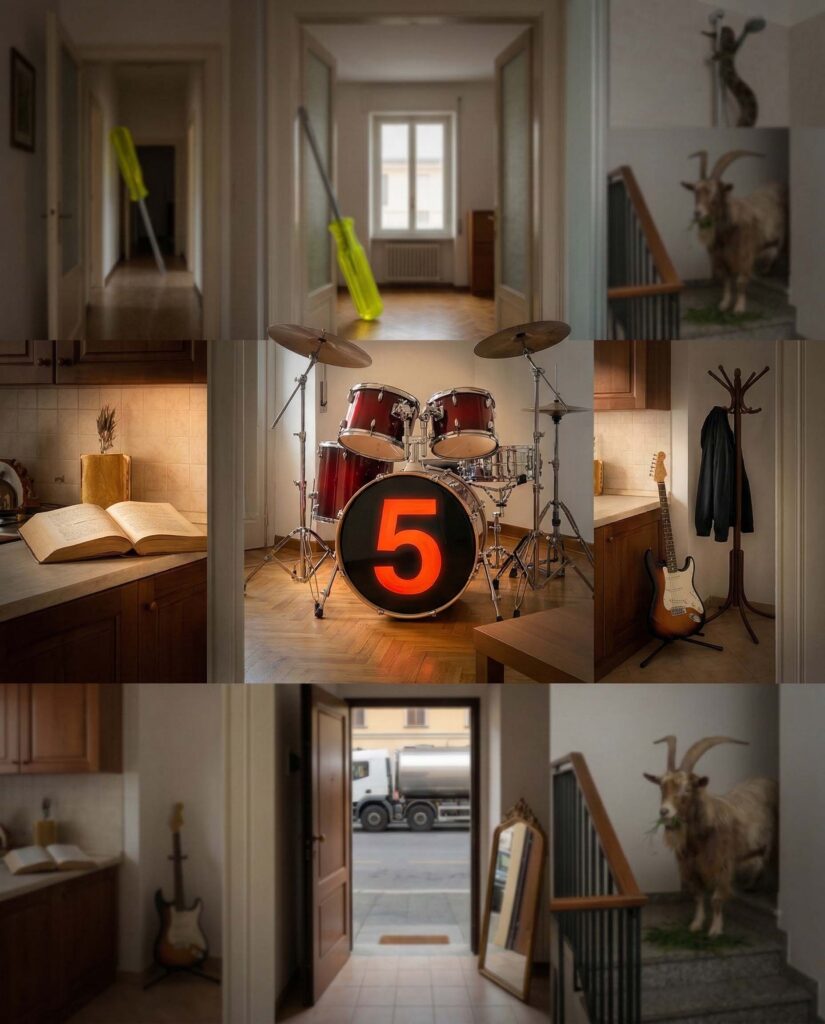
You turn to the opposite corner of the room and see a complete DRUM KIT. Bass drum, snare, cymbals, toms. It is a rockstar’s drum kit. But there is a crucial detail: painted on the skin of the largest drum is a huge NUMBER 5. Red, flaming. Sit down and play it. Boom! Crash! Boom-Boom Crash! Make some noise. Feel the vibrations in your ears. Associate the sound with the number 5.
- Keyword: DRUM KIT.
Stop 6: The Kitchen (Locus 6)
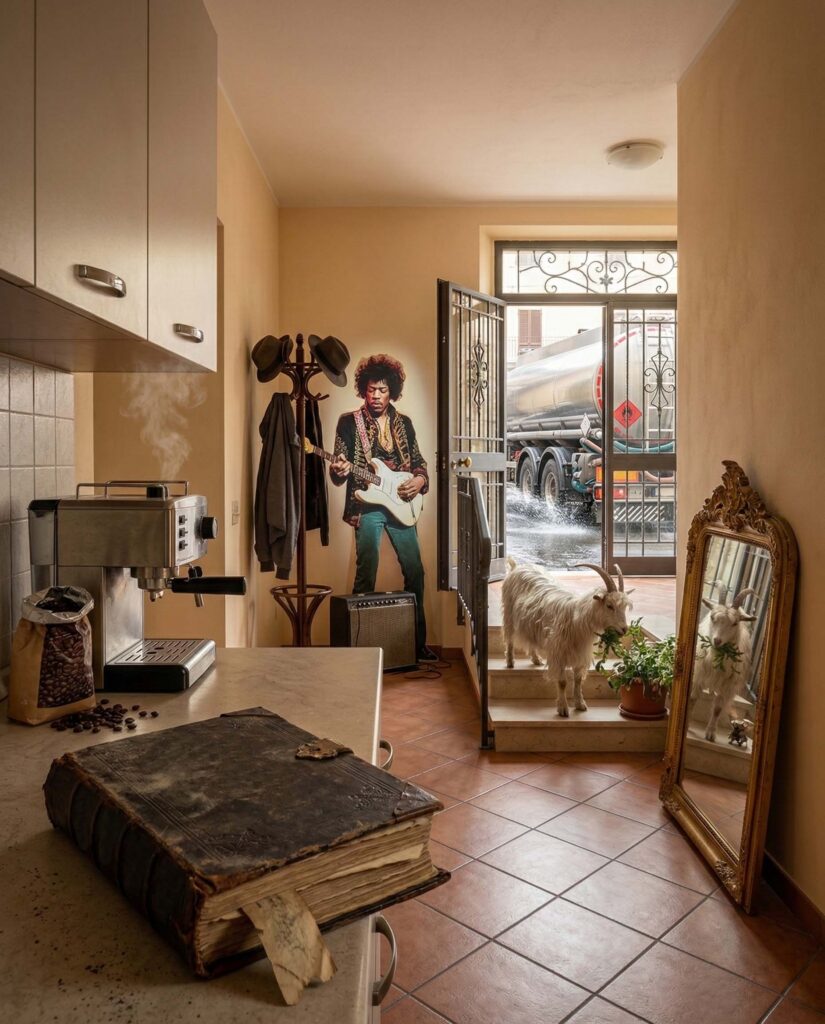
You leave the noise behind and enter the kitchen. On the counter, where you usually make coffee, there is a BOOK. It’s not just any book. It is ancient, dusty, a Greek classic, or perhaps a comic book. Bring your nose close: smell the old paper and glue. Flip through it quickly, hearing the sound of the pages. What is on the cover? Visualize it clearly.
- Keyword: BOOK.
Stop 7: The Entryway (Locus 7)
You head toward the front door to leave. There in the entryway, leaning against the coat rack or held by someone, is a GUITAR. Who is playing it? Is it Jimi Hendrix playing a distorted solo? Or a singer you detest? Or maybe it’s your old acoustic guitar? Pluck the strings. Hear the difference in sound compared to the drum kit earlier. It is a melodic, acoustic sound.
- Keyword: GUITAR.
Stop 8: The Stairs / Garden (Locus 8)
You open the door and step out. On the stairs or in your garden, you are faced with an absurd pastoral scene: a GOAT. It is there, calm, chewing on the lawn grass or your neighbor’s plant. It has white fur and curved horns. Hear its sound: Baaaa! Pet it: the fur is coarse and oily. Smell the typical animal scent. It is a total paradox to find a goat on your doorstep.
- Keyword: GOAT.
Stop 9: The Gate / Front Door (Locus 9)
You reach the main gate or the building’s front door. There, blocking your way or leaning against the wall, is a large MIRROR. It is an antique mirror with a golden frame, or a funhouse mirror. Look into it. What do you see? Yourself distorted? Or do you see a monster? The sunlight reflects off the surface and blinds you.
- Keyword: MIRROR.
Stop 10: The Street (Locus 10)
Finally, you are on the street. Suddenly, you hear a loud horn. A huge TANKER TRUCK is parked right there or speeds past you. Is it carrying gasoline (smell the chemicals?), milk, or water? Maybe it drives through a puddle and splashes you from head to toe. Feel the cold water, the anger, the noise of the diesel engine. It is the last object, the biggest and loudest.
- Keyword: TANKER TRUCK.
3. The Verification: Rewinding the Tape
Now stop. Take a deep breath. Do not try to remember the words. Just mentally repeat the path you just took.
- You wake up and on the nightstand is… (The treasure?) -> Wallet.
- You go to the shower and are scared of the… -> Snake.
- In the hallway is a giant tool… -> Screwdriver.
- On the living room table, you eat a fruit… -> Watermelon.
- In the corner is a noisy instrument with the number 5… -> Drum Kit.
- In the kitchen, you smell the paper of a… -> Book.
- In the entryway, Jimi Hendrix plays the… -> Guitar.
- Outside the house is an animal bleating… -> Goat.
- At the gate, you see your reflection in a… -> Mirror.
- On the street, you get splashed by a… -> Tanker Truck.
Did you get them all? I am sure you did. And it doesn’t end there. Try saying them backward, from the street to the nightstand. Tanker, Mirror, Goat… you will see the images flow like a movie.
The Number 5 Trick
I asked you to visualize a “5” on the drum kit. Why? If I ask you: “What is the seventh object?”, you don’t have to start from the beginning. You know the drum kit is 5. Go to the drum kit -> kitchen (6, Book) -> entryway (7, Guitar). You have just transformed a sequential list into a rapid-access database. This is the power of numerical structuring of Loci.
4. Scientific Analysis: Why Does It Work?
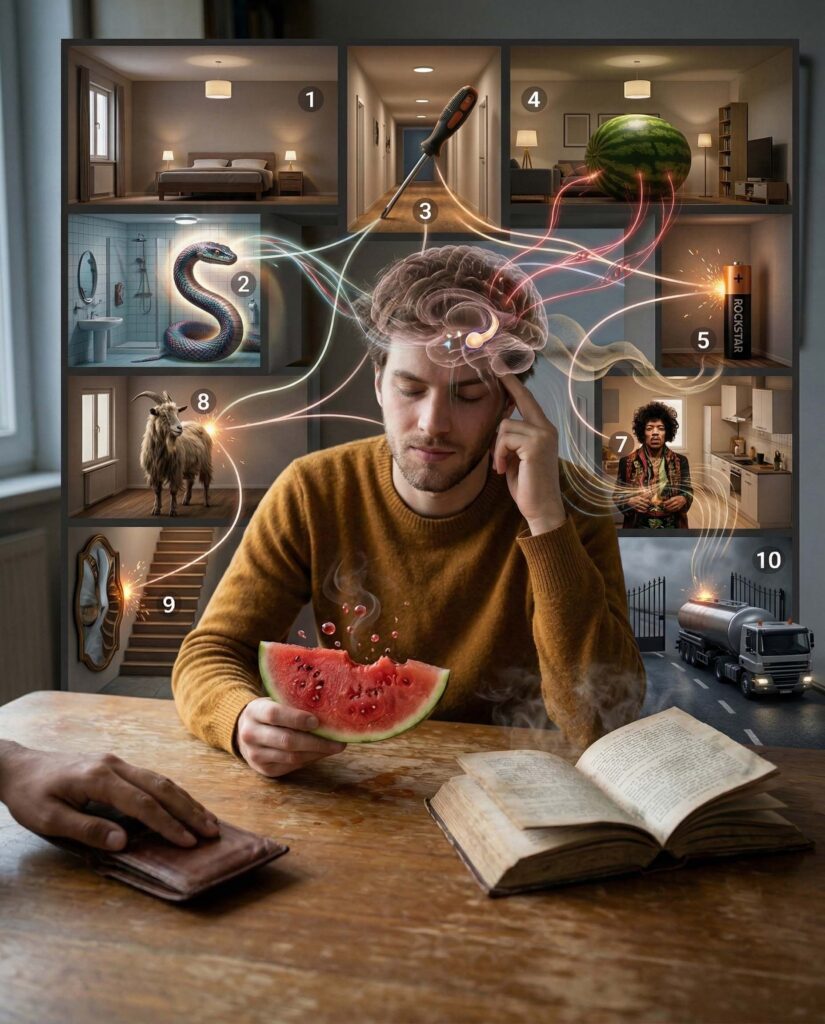
What you have just experienced is not magic; it is applied neuroscience. This exercise leverages three biological mechanisms discussed in our theoretical lessons:
- Spatial Navigation (Hippocampus): The human brain evolved to remember paths (where the water is, where the lion’s den is). By using your home, you leveraged an existing and consolidated “neural map,” pasting new information onto it. You didn’t have to make an effort to remember the order of the rooms; it was already there.
- Multisensory Encoding (Sensory Cortex): We didn’t memorize the word “Watermelon” (abstract symbol). We memorized the red color, the sweet taste, the sensation of freshness. We activated visual, gustatory, and olfactory brain areas, creating multiple neural “hooks” for the same concept.
- Paradox and Emotion (Amygdala): The snake in the shower or the goat on the stairs are paradoxical events. The amygdala flags these events as “relevant” for survival or curiosity, preventing the hippocampus from deleting them as “background noise.”
5. Expanding Your Palace
Now that you have memorized 10 objects, you might ask: “Can I do this with 100?” The answer is yes.
The limit is not your memory, but the number of Loci you have prepared.
- To memorize 20 objects: Instead of one object per room, place two (one at the entrance of the room and one at the exit).
- To memorize 50 objects: Use more details of the same room (nightstand, bed, wardrobe, window, chandelier).
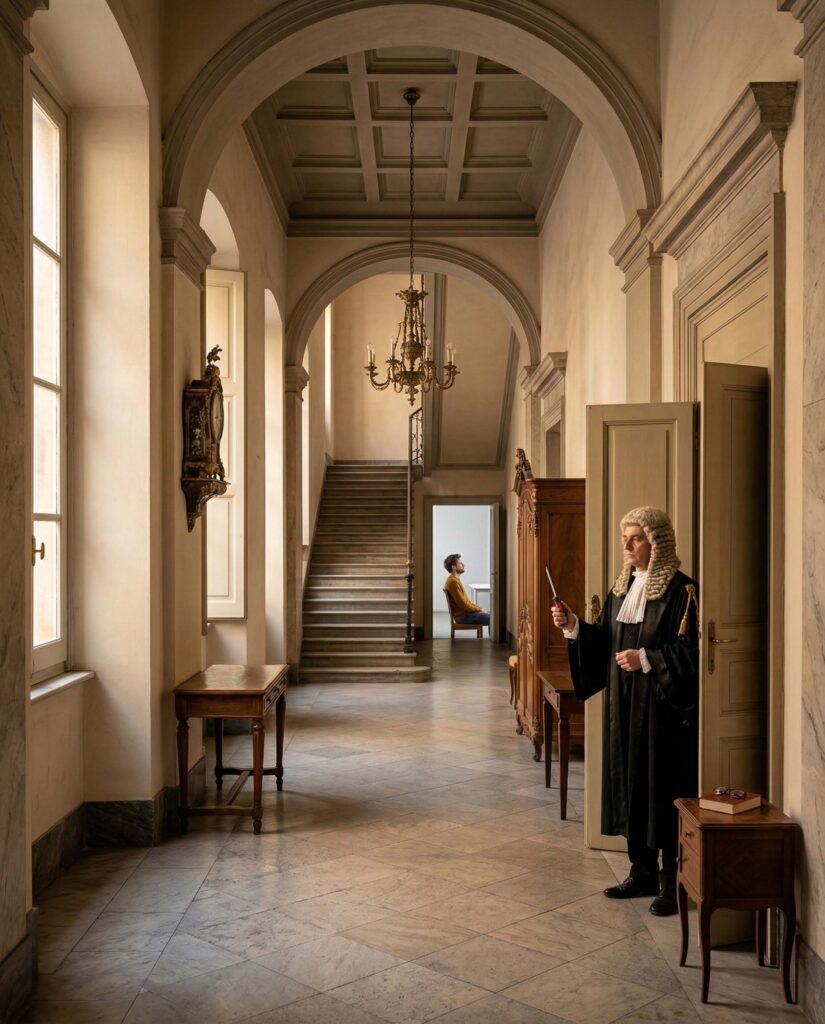
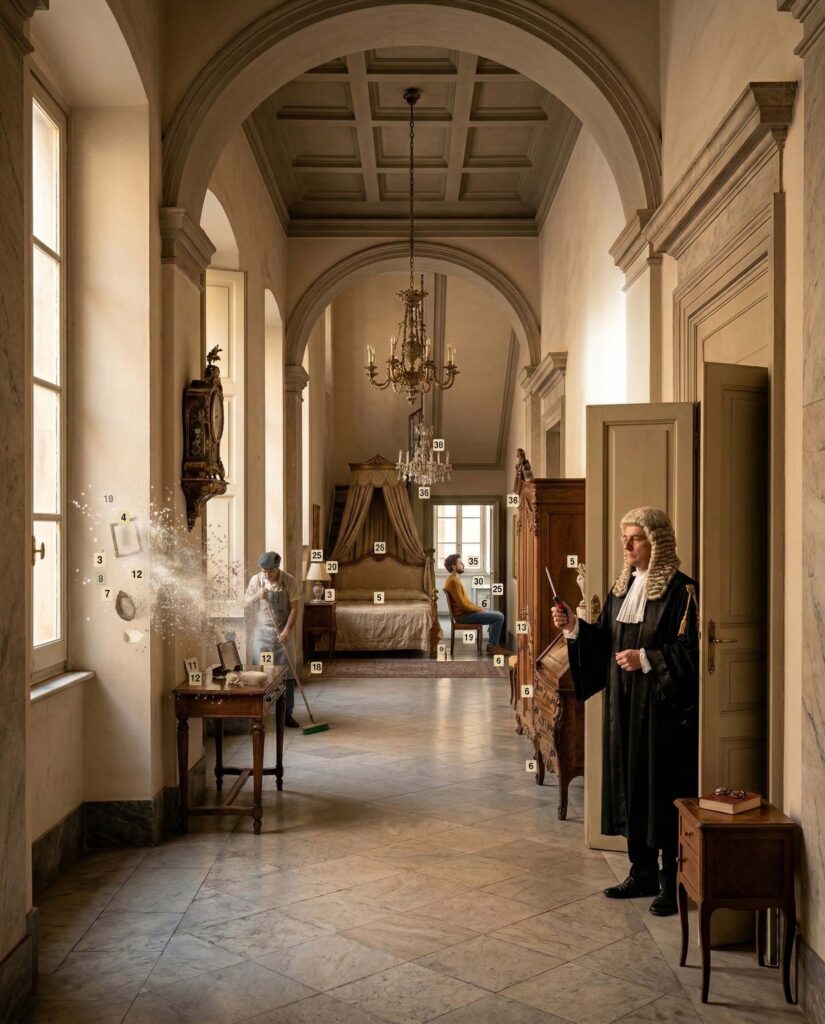
- To memorize abstract concepts: If instead of “Screwdriver” you need to remember “Justice,” visualize a judge holding a screwdriver (Image Agents technique applied to Loci).
Palace Maintenance
A common question is: “Will these images stay there forever?” If you don’t review them, they will gradually fade (forgetting curve), leaving the Palace clean and ready to be reused for a new list. If you want to keep them (e.g., for an exam), you must mentally walk the path once a day for a week (Spaced Repetition).
Conclusion: Your New Superpower
You have just completed your first true mnemonic construction. You are no longer a person with a “normal memory.” You have a method.
The Memory Palace is a technique that requires practice. The first time (today) it took you a few minutes to visualize everything. With practice, you will be able to place an object in a Locus in less than 2 seconds. Imagine what it means for your university or professional career to be able to memorize a list of 30 key points of a speech in one minute.
Continue practicing with random lists during the day: the grocery list, things to pack, tasks to do. Transform your life into a mental journey.
FAQ – Frequently Asked Questions about the Exercise
I can’t visualize images well, is that bad? No. Not everyone has “photographic” visualization. What matters is the concept of the image and the spatial sensation. Even if the image is blurry, if you know that “there is a screwdriver there,” the technique works.
I got confused between the living room and the kitchen. This happens if the path is not well defined. Make sure to always follow the same direction (e.g., clockwise) and not walk through walls. The path must be physically walkable.
Can I use a friend’s house? Yes, any place you know well works. Your grandparents’ house, your school, your office, the park. The more places you know, the more “hard drives” you have.
Did you enjoy the experiment? Did you manage to remember all 10? Write your result in the comments and tag Salyvan Academy. Your mind is more powerful than you think.
INFOGRAPHIC: